

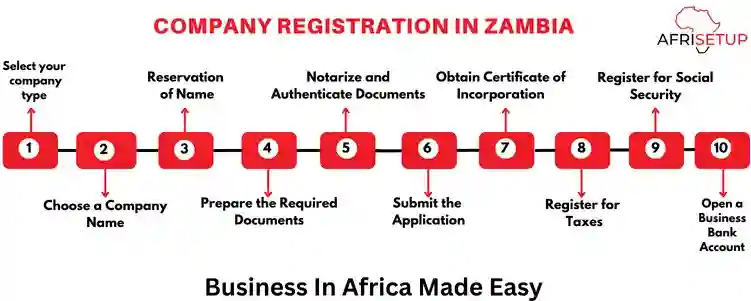
Company registration in Zambia offers foreign investors a straightforward gateway into one of Southern Africa’s most investment-friendly economies. Zambia company registration allows foreign nationals to own 100% of a company, with incorporation through the Patents and Companies Registration Agency (PACRA) completed in as little as 24 hours to a few days via the online system. In most cases, a foreign-owned business can become fully operational—including obtaining its certificate of incorporation, tax registration, and opening a corporate bank account—within 2–4 weeks.
As Africa’s second-largest copper producer and a member of COMESA, SADC, and the AfCFTA, Zambia provides businesses with access to a vast regional market. This guide explains the company registration process in Zambia, available business structures, required documents, registration costs in USD, tax obligations, and the Zambia Development Agency (ZDA) incentives and investor permit requirements that foreign entrepreneurs should consider.
| Authority | PACRA | Foreign ownership | Up to 100% |
| Incorporation | 24 hrs to a few days | End-to-end | 2-4 weeks (foreign-owned) |
| Corporate tax | 30% (VAT 16%) | Min. nominal capital | ZMW 20,000 (~USD 740) |
Free download
The Zambia Company Registration Checklist
Every step, form, document and fee in one printable 2-page PDF plus the foreign-investor essentials (permits, exchange controls, repatriation) most guides leave out.
Why Register a Company in Zambia?
Company registration in Zambia offers investors access to one of Southern Africa’s most business-friendly economies. The country welcomes foreign investment through a stable legal framework, attractive incentives, and strategic access to regional markets.
Key benefits include:
- 100% foreign ownership – Foreigners can fully own a Zambian company without a mandatory local shareholder.
- Free repatriation of profits – Investors can transfer profits, dividends, and capital abroad under Zambia’s liberalised exchange regime.
- Regional market access – Zambia is a member of COMESA, SADC, and the AfCFTA, providing access to major African markets.
- Abundant natural resources – The country offers opportunities in mining, agriculture, manufacturing, tourism, and renewable energy.
- Investment incentives – Qualifying projects may benefit from tax holidays, customs duty exemptions, and VAT relief through the Zambia Development Agency (ZDA).
- Simple registration process – PACRA’s increasingly digital registration system makes company incorporation faster and more efficient.
Types of Companies in Zambia
Before registering a company in Zambia, it is crucial to understand the many types of companies that can be incorporated under the Zambia Company Act. The Act divides companies into two categories: public and private, with additional subdivisions.
1. Public Companies
Public corporations are subject to additional rules and transparency requirements compared to private companies and can market their shares to the general public. Before issuing shares, public companies must register a prospectus with the Patents and Businesses Registration Agency (PACRA) and have at least 7 members and 2 directors.
2. Private Companies
Private companies in Zambia fall under three categories:
a. Limited by Shares—This business has a limited obligation to its shareholders, making it the most popular. After they have invested their money, the shareholders are not responsible for the company’s debts.
b. Limited by Guarantee—This kind of business has members who serve as guarantors rather than having share capital. If the company must liquidate, the guarantors commit to paying a predetermined sum of money. This kind of business is usually used for nonprofit, charitable, religious, educational, or community-focused organizations.
c. Unlimited Companies—In this structure, the members of this kind of business are not subject to any restrictions on their responsibility. Members are equally and severally liable for all of the company’s debts and obligations, including using personal assets. This sort of organization is uncommon and commonly used when extra flexibility is required in capital structure or internal management.
Other Business Entities
- Sole Proprietorship (Business Name): To register a sole proprietorship, you must know that the business owned and run by one person. It is not a separate legal entity from the owner.
- Partnership: A business structure where two or more people share ownership and responsibility.
- Foreign Company (Branch Office): An existing company incorporated outside Zambia that registers a local branch to operate within the country.
Note: Under the Zambian Companies Act of 2017, foreign investors can proceed with the registration of a company in Zambia with only one director and no requirement for Zambian shareholders. Most investors prefer to register limited liability corporations—typically private companies limited by shares—because this structure provides legal protection and is easy to set up. These companies can be private or public, depending on their needs.
Choosing Your Business Structure
| Private Ltd (subsidiary) | Foreign Company (Branch) | Business Name | |
| Legal status | Separate Zambian entity | Limited to company | No separate identity |
| Foreign ownership | 100% | 100% | 100% |
| Liability | Limited to company | Parent liable | Unlimited (personal) |
| Min. capital | ZMW 20,000 | n/a (parent) | None |
| Directors | Min. 2; half resident | Resident agent + director | Owner(s) |
| Best for | Most foreign investors | Extending a parent | Very small / test |
How to Register a Company in Zambia | Zambia Company Registration
At Afrisetup, we have streamlined online company registration in Zambia, allowing you to complete the process from the comfort of your home country. The Patents and Companies Registration Agency (PACRA) is the regulatory body responsible for company registrations, with applications submitted to the Registrar of Companies. To register, an applicant must be 18 years or older, of sound mind, and not an undischarged bankrupt.
We follow the steps below to ensure a successful process for company registration in Zambia:
Step 1: Decide the Type of Business to Register
Start by deciding whether to register a business name or a company. The two structures are legally different:
- A business name has no separate legal identity and carries unlimited personal liability.
- A company is a separate legal entity with limited liability and perpetual existence.
Step 2: Apply for Name Clearance
Apply to PACRA for name clearance, proposing up to three names in order of preference. If approved, the name is valid for 30 days and an official name acceptance letter is issued.
The name may be registered within 30 days or reserved for a further 90 days. If not used or reserved, the name expires and a new application is required.
Note: Forms: All application forms are obtained from PACRA and must be selected according to the chosen business type.
Step 3: Complete the Relevant Registration Forms
After name clearance approval, proceed with registration based on the approved business type:
- Business Name: Complete BN Form III – Application for Business Name Registration
- Local Company: Complete Companies Form 3 – Application for Incorporation
- Foreign Company: Complete Companies Form 38 – Application for Registration of a Foreign Company
Important: The approved name must match the business type selected at name clearance. A business name approval cannot be used to register a local or foreign company.
Step 4: Prepare the Incorporation Documents
In addition to the registration forms, applicants must prepare supporting incorporation documents required by PACRA.
- A copy of the proposed Articles of Association or a statement confirming adoption of standard articles
- Declaration by the applicants confirming that the particulars of the beneficial owners have been submitted to the Registrar
- The proposed type of company being formed
- The nature of the company’s proposed business activities
- The amount of share capital of the company and the division of shares among subscribers
- The date when the company’s first financial year will end
- The name and address of the individual lodging the application
- Registered postal address, email address, and phone numbers of the company
Step 5: Notarize the Declaration of Compliance
Complete Companies Form 11 (Declaration of Compliance) and have it signed before a Commissioner of Oaths. This confirms that all legal requirements under the Companies Act have been met.
Step 6: Submit Registration to PACRA
Submit the completed incorporation documents to PACRA and pay the applicable fees for Zambia company registration.
Local companies must submit:
- Companies Form 3 – Application for Incorporation
- Companies Form 5 – Consent to Act as Director/Secretary
- Companies Form 11 – Declaration of Compliance
- Registered office address in Zambia
- Certified ID copies of all directors, shareholders, and secretaries (NRCs for Zambians, passports for foreigners)
- Statement of Beneficial Ownership – full names, date of birth, nationality, country of residence, residential address, and any other particulars required
- Particulars of the first directors of the company
- Particulars of the first secretary or joint secretaries of the company
- Registered postal address, company email address, and phone numbers
- Details of the company’s share capital and share allocation to subscribers
- Proposed business activities of the company
Foreign companies (branches) must submit:
- Companies Form 38 – Application for Registration of a Foreign Company
- Certificate of Incorporation from the home country
- Constitutional documents (charter, statutes, or equivalent)
- Details of a resident Zambian documentary agent – local authorized contact for PACRA; not a director or shareholder.
- Certified ID copies of all directors, shareholders, and secretaries (passports for foreigners, NRCs if any Zambian nationals are involved)
- Statement of Beneficial Ownership – full names, date of birth, nationality, country of residence, residential address, and any other particulars required
Step 7: Receive the Certificate of Registration
Once PACRA approves the application and fees are paid, a Certificate of Registration is issued.
Upon successful incorporation, the Registrar may also issue a Certificate of Share Capital in the name of the company.
This marks the official completion of the process of company registration in Zambia, which typically takes about 7 business days from submission to issuance of the Certificate of Registration.
Cost of registering a company in Zambia
The official cost of registering a private company limited by shares in Zambia starts at approximately USD 72 (K1,300) when registering with the Patents and Companies Registration Agency (PACRA). This estimate assumes a minimum nominal share capital of K20,000, and the total cost may be higher depending on the company’s share capital.
The standard government fees include:
- Name reservation: USD 6 (K111)
- Company incorporation fee: 2.5% of the nominal share capital (minimum USD 28 (K500))
- Certificate of Incorporation: USD 11 (K200)
- Certificate of Share Capital: USD 11 (K200)
- Declaration of Compliance and Consent: USD 22 (K400) – K200 for each required document.
Note: The USD amounts are approximate and may vary depending on the prevailing exchange rate.
Post-Registration Obligations in Zambia
After completing the process of Zambia company registration, your company must fulfill the following requirements to remain compliant:
- Register for Taxes: Obtain a Taxpayer Identification Number (TPIN) from the Zambia Revenue Authority (ZRA) and register for the applicable taxes.
- Corporate Income Tax: Companies are generally subject to 30% corporate income tax. Reduced rates apply to qualifying sectors, such as 15% for non-traditional exports and farming.
- VAT Registration (if applicable): Register for 16% VAT once your business meets the statutory registration threshold.
- Withholding Tax: Dividends, interest, and royalties are generally subject to 15% withholding tax, although this may be reduced under an applicable double taxation treaty.
- Employer Obligations: Register with NAPSA, NHIMA, and the Workers’ Compensation Fund Control Board. Employers contribute 5% to NAPSA and 1% to NHIMA, with employees contributing the same percentages. You must also deduct and remit PAYE on employee salaries.
- Open a Business Bank Account: Use your Certificate of Incorporation and other company documents required by your chosen bank.
- Licences and Permits: Obtain and renew any industry-specific licences or regulatory approvals required for your business activities.
- Annual Returns: File annual returns with PACRA within 3 months after the end of your financial year. Zambia’s tax year ends on 31 March.
- Other Taxes: Depending on your business activities, you may also be liable for Property Transfer Tax (3%). Zambia currently does not impose capital gains tax
Completing these steps ensures your company operates legally, avoids penalties, and maintains good standing in the country. Contact Afrisetup today to assist you with Company registration in Zambia.
Free download
The Zambia Company Registration Checklist
Every step, form, document and fee in one printable 2-page PDF plus the foreign-investor essentials (permits, exchange controls, repatriation) most guides leave out.
Important Considerations for Foreign Investors
If you are a foreign investor planning to register a businessn in Zambia, keep the following points in mind:
- Resident director or representative: Foreign investors can own 100% of a Zambian company. However, at least half of the company’s directors must be residents of Zambia. If you are registering a branch office, you must appoint a resident documentary agent. Afrisetup can assist with these local representation requirements.
- Investor and work permits: If foreign shareholders or directors intend to live and work in Zambia, they must obtain the appropriate Investor’s Permit or Employment Permit from the Department of Immigration.
- Investment incentives: Tax incentives offered by the Zambia Development Agency (ZDA) are available only for qualifying investments, typically from USD 500,000 in approved priority sectors or Multi-Facility Economic Zones (MFEZs). These incentives are optional and not a requirement for company registration.
- Industry-specific licences: Businesses operating in regulated sectors such as mining, banking, insurance, energy, and telecommunications must obtain additional licences from the relevant regulatory authorities after incorporation.
- Remote company registration: Foreign investors can register a company in Zambia remotely by appointing a local representative and submitting the required notarised documents, eliminating the need to travel to Zambia during the incorporation process.
FAQs About Company Registration in Zambia
A minimum of one shareholder is required to register a company in Zambia. The shareholder can be an individual or a corporate entity.
Private companies typically have a minimum nominal share capital of around K15,000–K20,000, while public companies usually require higher capital, often in the millions. The exact figure depends on regulatory practice, but share capital must be stated in the incorporation documents and reflects the company’s financial structure.
Company Setup in Zambia takes approximately 5-10 working days, depending on the availability of the required documents for registering a company in Zambia. It is important to note that this timeline can vary.
Yes, you are required to provide a physical office address in Zambia as part of the company registration process. This address will be used for official correspondence. We are happy to offer you our address for the purpose of company registration. You can change it later once you get your own office.
Companies must file annual returns with PACRA, maintain accurate Beneficial Ownership (UBO) records, and pay taxes to the Zambia Revenue Authority (Corporate Income Tax, PAYE, VAT). They must also comply with labour laws, including social security (NAPSA) and health insurance (NHIMA) contributions, to remain in good standing.
Costs include fees for reserving a company name, submitting incorporation forms (Form 2, Form 5, Form 11), ID verification, and proof of address. Additional charges depend on share capital, stamp duty, certificates, and optional expedited services. Post-registration, businesses may also incur costs for tax registration, bank accounts, and annual returns.
Registering a business name involves paying for name clearance/search and submission of the registration form with ID and address proof. Total costs vary slightly with updates but generally cover the name reservation, registration, and certificate issuance. Name reservation can be completed quickly if all forms and documentation are correctly submitted. For the actual figure, please feel free to contact us.
Yes. Foreign investors can fully own a local company or register a sole director company without any Zambian shareholders. Most foreign investors set up a limited liability company to comply with Zambian corporate law while retaining full ownership.
To obtain a business permit, register the business with PACRA, get a Taxpayer Identification Number (TPIN) from ZRA, and acquire any local council permits. Foreign investors must also secure an Investment License from the Zambia Development Agency (ZDA) and an Investor’s Permit from the Immigration Department.
The business name reservation process can be completed within 24 hours if all forms are correctly filled. Applicants must be at least 18 years old and of sound mind. Once approved, registration proceeds with submission of ID and proof of address.
No. Clubs, associations, churches, and similar organizations are registered with the Registrar of Societies, not PACRA.
You don’t need a Zambian shareholder, but PACRA expects at least half of a company’s directors to be
resident in Zambia. Many foreign investors use a resident nominee director, which Afrisetup can
arrange.
Corporate income tax 30%, VAT 16%, 15% withholding tax on dividends/interest/royalties, PAYE on
salaries, NAPSA (5%+5%) and NHIMA (1%+1%). There is no capital gains tax; property transfers
attract a 3% transfer tax.
Conclusion
Company registration in Zambia is crucial for entrepreneurs aiming to establish a legal entity and unlock various opportunities. By following the outlined registration process and fulfilling compliance requirements, you can ensure the legal recognition, limited liability protection, and credibility necessary for your business’s success. We are happy to hold your hand so that you can confidently embark on your entrepreneurial journey in Zambia.
Contact us today to complete your business registration in Zambia quickly and hassle-free.